
Rating: My Bookshelf
Reading Level: Early Elementary, Mid-Late Elementary, All ages
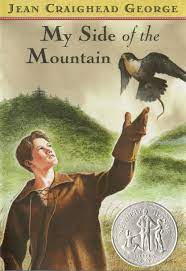
This is such a lovely story of adventure, perseverance, and learning to make do with what we have. A young boy goes off-grid to live off the land. The author includes diagrams how to make traps, ways to find food in the wild, recipes, etc.
Possible Concerns:
- Stranger Danger. At one point the main character meets a stranger, assumes he is an outlaw, invites him into his shelter, and befriends him. It turns out the “stranger” is a professor on holiday & becomes a great & dear friend. Nevertheless, it might be worth discussing hospitality vs. avoiding strangers in the woods!
- Hitchhiking. Initially the boy arrives at his family’s bit of forest by way of riding in cars with strangers willing to pick him up. Obviously, this book was written in a much different time and context.
- Running Away from Home. To be fair, Sam tells his parents exactly what he plans to do & where in the forest he plans to go. His motives for leaving are not bad. He is not angry with his his parents or in rebellion. He simply longs for a different life—a simple life—and the confidence to know he could make it! (Wouldn’t we all love the, chance to pass nature’s test and live through the tough winter months up in the mountains?!!!) His parents expect him to be home by suppertime, but instead he seeks to make it on his own and even survive through the tough winter. But his honesty about the troubles he faces and the things he eats might help your kid contemplating a similar path to count the cost and realize perhaps home isn’t so bad after all!
- Lying. While Sam is perfectly honest with his parents (and some others) about his intentions to go on a survival adventure, with at least one boy (a student news reporter) and perhaps a few others, Sam makes up false stories to throw them off the scent of his trail and preserve his lifestyle. This could spark meaningful conversations with young learners about when (if ever?) it may be appropriate to bend the truth, or how folks in history may have been tempted to do so (underground railroad, conspiracies against Nazi regimes, David’s deceitfulness when fleeing from Saul which led to the murder of a priest’s family, Mordecai s advice to Esther to hide her heritage, etc.)
- Stealing. A couple times during hunting season Sam quickly steals a fallen deer before a hunter can find his prize. Sam uses the deer skins to make his front door and some much-needed winter clothes.
- Treatment of Animals. Sam climbs a cliff to capture a baby peregrine falcon and trains it to catch much of his sustenance. As with most falconers, the falcon is not “allowed” to eat its prey; Sam feeds it so as to preserve its captivity. All things considered, he is otherwise kind to the falcon, who serves as his companion.
- Halloween. The closest to any spirital tones are when Sam breaks his protocol on Halloween and leaves food out for the local wild animals. The “party” gets a bit wild and Sam links it to the holiday.
Although none explicitly spiritual, this classic has some fantastic themes:
- Perseverance & Patience, especially with long tasks (such as tanning your own deer hide).
- The wonders of creation/learning about all of God’s creation
- Appreciation for little things (e.g. enjoying a simple meal for sustenance instead of needing it to be processed in a factory and packed with sugar) and being being content with what one has, or making do with what one can find.
- The value of community (at some point Sam realizes he is lonely)
- self- sufficiency/problem solving
- learning from mistakes (Sam’s lived experience leads to wisdom)
*See also my review of the sequel, On the Far Side of the Mountain, which I view a bit less favorably than this one.
*You may wish also to see this book’s review on ChristianParentReviews.com: https://christianparentreviews.com/book-reviews/My-Side-of-the-Mountain
Discussion Questions:
(1) Have you ever wanted to run away from home? What happened? (I’m glad you came back!)
(2) Do you think you would ever like to spend time in the wilderness? What about it appeals to you?
(3) The main character prepares for the winter by storing up food. How does our family prepare for the future?
(4) The main character learns to be content with the food he can find. What ways can you work on being content with what you have?
(5) The boy’s challenge and dream is to make it through the winter. What is your challenge that you dream about achieving?
(6) When he learns to make fire, he feels he has the world at his fingertips. What skills and talents have you worked on that have made you more able to fulfill your purpose?
(7) What do you think about how Sam lies to the local school news reporter? Would there ever be occasions when it is appropriate to lie? What would we look for when deciphering whether we should bend the truth?
Looking for answers to the questions? Just let me know and I’d be happy to share! email: jesuslovesthebookwormmom@ngpjustice
Bottom line: As long as your 6-10 year old could be trusted with the concepts of “do not try this at home” (with regard to hitchhiking, climbing steep cliffs to catch falcons, etc.), I heartily recommend this book for the Bear Gryllses in your family. No violence or sexual tones; themes of patience and enjoying creation make this a real beauty.
**You may also wish to check out the review of this book on ChristianParentReviews.com: https://christianparentreviews.com/book-reviews/My-Side-of-the-Mountain
*This topic originally appeared in my other blog, Tumbling Into Proverbs 31: Reflections on seeking God as I tumble into all facets of being a wife, mother, and woman working outside the home. Read more at tumbling31.wordpress.com.
Discover more from Jesus loves bookworms
Subscribe to get the latest posts sent to your email.
 Jesus loves bookworms