
Rating: Needs Parent Supervision
Reading level: High School
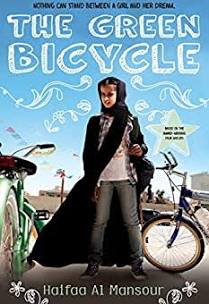
The Green Bicycle offers a peak into the struggles of a Muslim adolescent girl named Wadjda as she fights pressure to conform to cultural norms in Saudi Arabia. The book is brutally honest (and both implicitly or explicitly critical of) Muslim traditions, norms, beliefs, and culture.
A good one for families that want to discuss Islam with their kids, challenge their kids to ask tough questions about implications of religious convictions, and want to glimpse a non-western culture. I took religion courses in college and knew some basic principles of Islam, but OHHH MY!— what an eye-opening privilege to see how the principles play out in everyday life. I know Western culture isn’t perfect but it sure beats what this poor girl deals with.
Here are just a few examples of how you get a peak into the culture:
- The story begins in a school assembly where the girl must sing about how the key to get to heaven is to fight fight fight: “If our religion is humiliated, heaven calls and our fate is written…we fight!”
- Women are not allowed to drive cars (so must pay for taxi drivers to take them to work every day.) Girls and women don’t ride bikes.
- Women must wear black draped around most of their bodies even in the blazing hot sun. Men wear white.
- Men may take multiple wives and neglect their first families socially and financially. Men don’t help around the house.
To really see these types of cultural norms in action just made me so thankful for what Jesus has done to revolutionize the role and purpose and treatment of women in society. I’m so thankful to have a husband who models after Jesus’s strong selfless service and who is nothing like the men in this book.
Things I don’t like / considerations to be aware of: (there are spoiler alerts in here so read on only if you don’t mind knowing what happens.)
- Lying/Deceit. The main character does a lot of lying, deceiving, & sneaking. Most of it is because she is not eager to conform to the rules of the strict culture. A lot of the adults do the same lying and sneaking.
- Fear-based Marriage. The mother and father have a really unhealthy relationship. The mother spends most of the book trying to lure/persuade/beg/bicker with the father to convince him he shouldn’t obtain a 2nd wife. It is a fear-based relationship.
- Uninvolved Father. The father is barely around, doesn’t always live with them, doesn’t provide financially but always seems to have a new cell phone and when he does show up, he doesn’t help with cooking or cleaning; he just plays video games.
- Verbal Sexual Abuse. In one chapter, Wadjda walks past a construction site where the workers make inappropriate remarks inviting her to “come play with us” so he can “touch those little apples.” She feels fear and shame. Later she wants to tell them they should be nicer and “not take their frustrations out on little girls” and thinks about how we are all just trying to make it in this tough world they live in.
- Blackmail. In one chapter, the kids use blackmail to help the mother get out of a desperate situation.
- Smoking & Depression. The mother smokes and tries to hide it. She also has a bout of depression and she doesn’t handle it in healthy ways. Frankly, if I didn’t have Jesus & I was in her situation I don’t think I would do any better.
- Virginity & superstition about bicycles. When Wadjda falls off her bike and scrapes her knee, the mother freaks out when she sees blood, worrying that she “lost her virginity.” This comes up a couple times related to superstition about riding a bicycle.
- Poor treatment of women. Wadjda’s father is given an ornate image of a family tree which doesn’t represent women. So since Wadjda is an only child, the tree stops at her dad. She takes a piece of tape and adds her name under him, but in a heartbreaking scene she finds the tree with her name removed again. This symbolizes an outright rejection of her by her father: she just isn’t good enough.
- Suspected homosexuality/shaming. Two girls are caught with Western magazines and try to hide them under eahothers’ clothing. It is suspected they were “touching each other” and are publicly humiliated for something they didn’t do.
- Islamic scripture. To be aware of: near the end there is a lot of quoting the Quran, including longer passages recited more than once. Wadjda learns to recite it “from the heart” and this is maybe the first time that the Quran is painted in a positive light.
I think this book could inspire really rich conversation about how Christ revolutionizes culture. That said, your child should be mature enough to handle some tough issues and grapple with tough questions.
I’m not sure if I would encourage my sons to read it. There are some very feminine moments.
Discover more from Jesus loves bookworms
Subscribe to get the latest posts sent to your email.
 Jesus loves bookworms