
Rating: Not for me
Reading Level: Middle School
Several main characters battle—each in their own ways—the evil king who has taken over the empire.
There is a strong modernism influence (logic alone is supreme), as well as strong eastern meditation, and heavy atheism. A drunken festival with naked dancers. And lots of boring writing where a sage explains things to his mentee. It lacked creativity and got long and boring.
Major concerns:
- Worship of false gods. Deep explanation of the dwarf gods and goddesses.
- the assertion that logic is more powerful than wisdom
- Eastern meditation that brings us into consciousness with all living things, eventually achieving nirvana–loss of oneself in the union with all things.
- A compelling argument for atheism is offered. Moreover, the mentor basically uses the problem of pain to justify not worshipping
- I didn’t like a drunken seance that ended with two naked twins girating their bodies until a dragon tattoo rose off of their skin and came to life.
- Heavy sorcery. A student learns magic from an elf who he calls master. Practices include yoga, meditation, having mental connection with all the animals and plants, and a lot of weirdo religion dancing around here. It feels very much again like several hours of Luke Skywalker asking Yoda dumb questions (again). However, the magic and the structure of it in this world is more detailed, more explicit, and more pagan.
- Logic over wisdom. A sage asks his student, “what is the most powerful tool of all?” the student suggests determination (no), and then wisdom (no). The sage teaches him that logic is the most powerful tool. In the bible we are told that we should pursue wisdom above all else, and that the beginning of wisdom is knowing the Lord.
- Sex outside of marriage. A main character doesn’t fight it when his fiancé sneaks into his room at night to sleep with him. There are no details, save that she wakes up next to him in the morning.
- Sorcery based largely in drawing from elements of power (water, fire, etc.)
- The sage teaches the student several easy ways to murder someone using magic.
- The main character and his dragon share consciousness.
If you let your reader at this one, I’d recommend some deeper conversations about truth, morality, and ways of knowing what we know.
- Is logic supreme, as the book suggests? If not, then what?…
- How do we know if our actions are justified?…. Where does morality come from?
- The master elf says the evil and pain i evidence of an unworthy or non-existent God. What do you think?
One positive is that throughout the series there is a black female who ends up being an incredible leader. It was very refreshing to see such a positive model for young black women. (I think this character comes into the spotlight in Book 2.)
See my reviews of other books in the series:
| Eragon, (The Inheritance Cycle Book 1) | Paolini, Christopher | https://jesuslovesthebookworms.wordpress.com/?p=3688 |
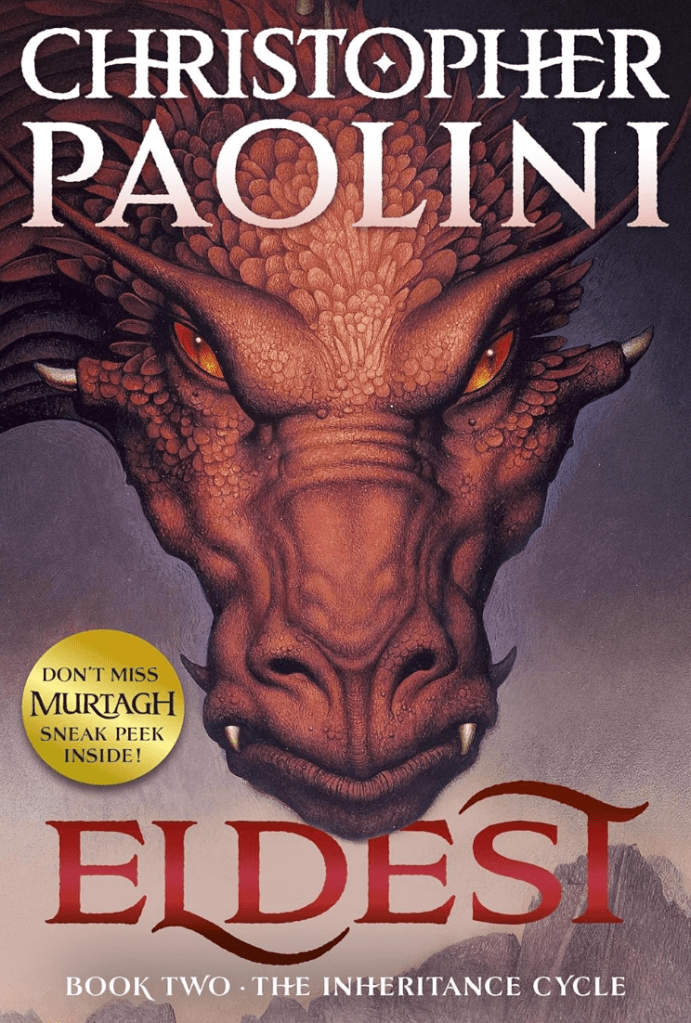
| Eldest, (The Inheritance Cycle Book 2) | Paolini, Christopher | https://jesuslovesthebookworms.wordpress.com/2025/03/29/eldest-eragon-the-inheritance-cycle-book-2-by-christopher-paolini/ |
| Brisingr, (The Inheritance Cycle Book 3) | Paolini, Christopher | https://jesuslovesthebookworms.wordpress.com/2025/04/07/brisingr-the-inheritance-cycle-book-3-by-christopher-paolini/ |
| Inheritance (The Inheritance Cycle Book 4) | Paolini, Christopher | https://jesuslovesthebookworms.wordpress.com/2025/04/14/inheritance-the-inheritance-cycle-book-4/ |
Discover more from Jesus loves bookworms
Subscribe to get the latest posts sent to your email.
 Jesus loves bookworms