
Rating: Needs Parent Supervision
Reading Level: Mid-Elementary, Late Elementary
At first I was not impressed by the potty humor and the lack of character displayed by Wolf and his friends. I almost put the book down, but I’m glad I stuck with it; it ended up having excellent opportunity to discuss the world’s view of what it takes to be good vs. a biblical view. Also, I liked that the bad guys eventually turned around, accepted consequences, and realized the joy in doing good.
Possible Concerns:
- Body and potty humor. There are definitely some fart jokes, and a big rock is repeatedly referred to as looking like a “butt.”
- Crime/Destruction/Menace to society. Initially the bad guys justify stealing and causing mayhem for the police force. I didn’t like how the book glorified destructive and selfish behaviors. I want to raise kids who are people of character who contribute to society, and if a kid doesn’t finish this book or doesn’t grasp the transformation that is portrayed then I think this book could have a negative effect on kids’ character.
- Calling weak and scared creatures “Losers.” In the introductory scene, the wolf and snake are in a cafe and they notice that all the other creatures are terrified and hiding from them. They refer to these creatures as losers and generally are prideful about their place in the food chain. I wasn’t excited about this egotistical behavior, whereas the Bible teaches us to care for the weak and lowly in society.
Things I liked: (spoiler alerts!)
- Character Transformation. The bad guys discover the joy in learning to do good. In many books with character transformation, the transformation happens at the very end and isn’t given much attention, so it’s easy to miss. But this book does a good job of really illustrating the transformation and spending time in it so that kids will hopefully soak up the good character traits in the end.
- Friendship. The bad guys take risks to honor their friendship with one of their team who appears to have turned to the dark side.
- All have sinned. The character who is initially posited as being humanitarian and general do-gooder in society is exposed as actually being an evil villain. This illustrates the principle that I’ll have sinned and fall short of the glory of God and there really are no humanitarian or philanthropists who have escaped the power of sin and death.
- Consequences. The bad guys do spend time in prison and they accept the consequences for their behavior even though they have sort of repented from it.
Overall, I think there are some great conversations to have with your kid to help develop the themes from a biblical perspective. Below I include some good discusion questions to chat about.
Discussion Questions:
- Culture’s favorite Public figures as sinners. Professor Marmalade is uplifted by the media as being a champion for good, but what is his true nature? (Answer: he was hailed in their culture as the ultimate example, but hidden under his persona was a very evil creature with selfish motives.) Can you think of any examples of people in our current media who are championed for being good? What do we know about their “goodness”? (Possible answer: we know that all have sinned and fall short (see Proverbs 20:9, Psalm 130:3, and Romans 3:10). All have evil motives, even if those motives go undetected. The people uplifted in the media should not be idolized; their righteousness is like filty rags. Instead of idolizing them, we can pray for them that they have a saving relationship with God.)
- Good vs. Bad. The book separates people into good guys and bad guys, two distinct groups. Do you think the Bible agrees with this separation? (The Bible separates sheep and goats, but it’s not based on works. It is based on faith in Christ as the atoning sacrifice.)
- Doing good. The bad guys discover the joy in doing good. Why do you think even non-Christians get joy from doing good? (Possible Answers: It could be a performance based mentality, or it could be because of Eph. 2:10: we were created to do good works, so even when non-Christians do good, they are living into their purpose).
- Motivation for doing Good. Christians have even further joy in doing good because we know it brings joy to God. How does your relationship with God help you to be a person of character? (God’s word guides us, God’s spirit gives us strength and changes our hearts to want to do what is right.) How does your relationship with God help you when you fail to be a person of character? (When we are weak we are strong because of Christ.)
- Consequences. The bad guys acknowledge that they have done bad things and they accept the punishment of prison time. Where in the Bible do we see characters accepting their punishment or consequences for their sin? (Possible answer: David mourns & yet accepts the death of his child after his sin with Bathsheba.)
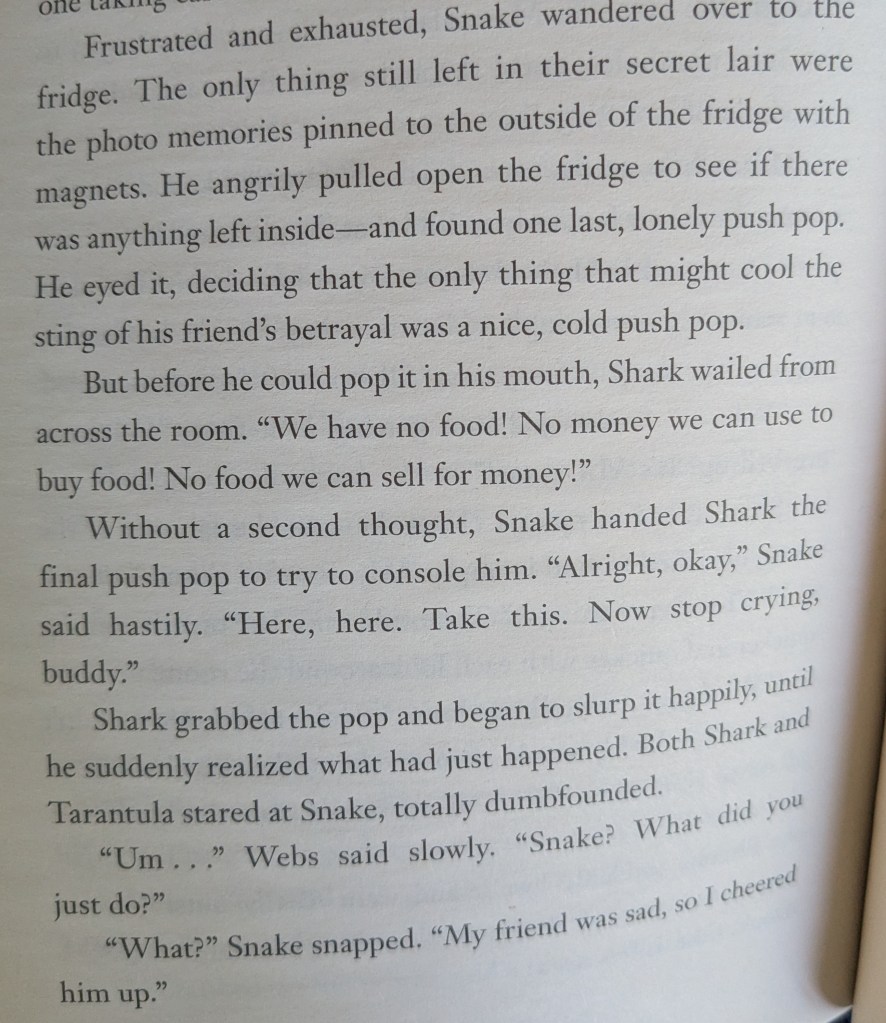
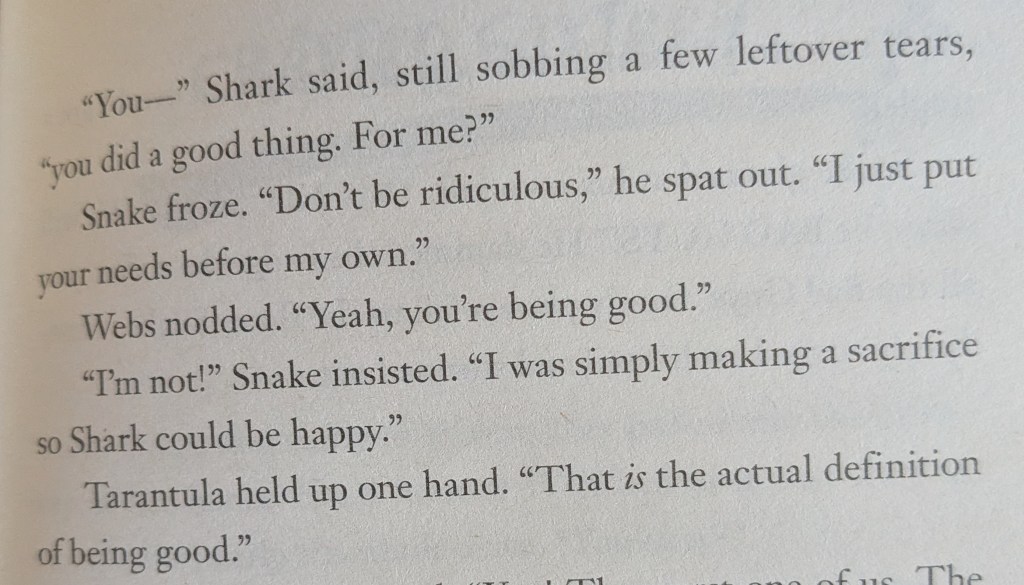
- Definition of Good. When snake gives the popsicle to shark, he argues that he wasn’t being good. (See excerpt below.). Tarantula says his explanation is the actual definition of being good. Do you agree? Why or why not? (Possible answer: We are only good through God alone, because our righteousness is like filthy rags. So this is not a definition of being good. However, what Snake described is a definition of *Love.* Putting others above ourselves is what we do when following Christ’s example, and it is a natural part of the sanctification process when we become more like Him. In short, we are only good through God, but what snake did does align with Biblical love.)
Discover more from Jesus loves bookworms
Subscribe to get the latest posts sent to your email.
 Jesus loves bookworms